

Showing posts with label Books. Show all posts
Showing posts with label Books. Show all posts
Monday, 1 November 2010
Friday, 27 August 2010
Inspiration by Hemingway
I love these motivational posters mocked up by the excellent Art of Manliness blog. This is inspirational!


Hemingway was a man who really lived, a serious inspiration.
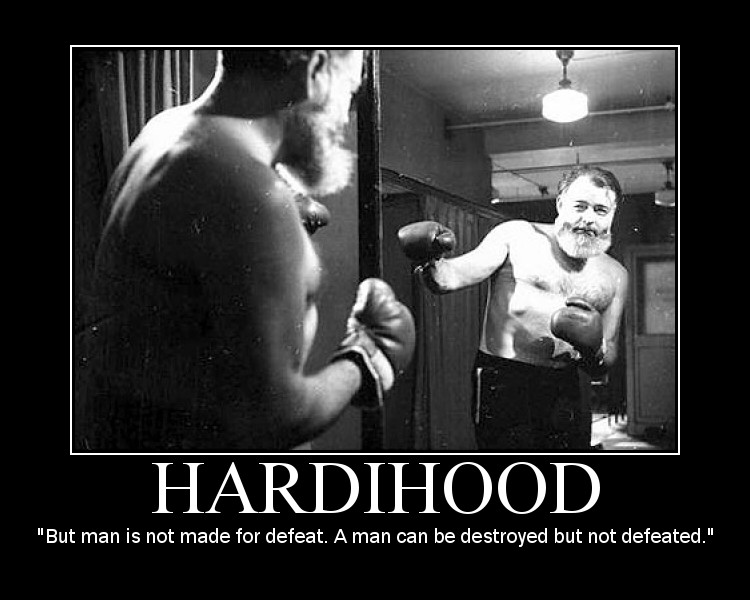

Hemingway was a man who really lived, a serious inspiration.

Thursday, 12 August 2010
Castaways of Disappointment Island
This looks fantastic. Shame I'll almost certainly never own it:

The book is intended for readers aged 10-12 years and (imagine this!) at the back of the book young readers are asked questions 'to test silent reading'.
An excerpt:
…we tramped forward with some heart, forgetting our past trials in the hope of speedy succour. More even than food, we longed for water; but we could find none. We toiled on, often having to stop from utter weakness, staggering like so many drunken men, racked with pain in every limb. Most of us had very little clothing; and the majority of us had kicked off our boots as I had done, to secure a last chance if we had been cast into the sea. Our feet were frozen and wounded; and altogether our plight was truly miserable.
By afternoon we were hungry - so hungry that we felt maddened. We had noticed a certain species of seabird called mollyhawks nested on the island in vast numbers. It did not prove a very hard task to get some of the birds but there was no way of cooking them; we could only skin them and eat them raw, tearing their warm flesh with our teeth.
Night came and still we had not found our longed for depot. We were so utterly exhausted that we had not the strength to try to crawl an inch. We just lay down full length on the mud and let the rain beat upon us, and wind howl around us; whilst from below we could hear the angry roar of the sea.
What a night of suffering that was…. As the light grew stronger the mist lifted and drifted away, and we were free to continue our journey once more.
Wet, covered with mud, the most pitiable objects that ever were seen, we staggered on, helping each other up when we fell, not making a mile an hour, but never giving up, urged on by the inspiring thought that at the end of the march we should find food and the means of getting a fire.
Now we were travelling over sharp, rocky ground which cut and wounded our feet until we left a trail of blood behind us; and then we would be going through long, rank grass, sinking up to our ankles in liquid mud. And so we went on, on, up and up, ever drawing nearer to the summit of the mountain, crawling at last on hands and knees - on and on, until at last the goal was reached, and we stood casting eager eyes around.
But why do those groans of bitter disappointment escape our lips, and why do we stare so wildly into each other's haggard faces? Oh, the bitter mockery of it! All our hard, wearisome, agonising climb had been for nothing! We were not on Auckland Island at all! That lay far away, with six miles of angry, fiercely-running sea between us and it.
We were on a bleak, barren island about three miles long and two wide. No trace of water, no sign of life of any sort could we see! All silence, all mountain, and scrub and loneliness, and all around the waves which, if we had escaped them, would now shut us in to die of starvation. We did not know the name of the island then, yet in our minds we named it aright - it was indeed Disappointment Island!

The book is intended for readers aged 10-12 years and (imagine this!) at the back of the book young readers are asked questions 'to test silent reading'.
An excerpt:
…we tramped forward with some heart, forgetting our past trials in the hope of speedy succour. More even than food, we longed for water; but we could find none. We toiled on, often having to stop from utter weakness, staggering like so many drunken men, racked with pain in every limb. Most of us had very little clothing; and the majority of us had kicked off our boots as I had done, to secure a last chance if we had been cast into the sea. Our feet were frozen and wounded; and altogether our plight was truly miserable.
By afternoon we were hungry - so hungry that we felt maddened. We had noticed a certain species of seabird called mollyhawks nested on the island in vast numbers. It did not prove a very hard task to get some of the birds but there was no way of cooking them; we could only skin them and eat them raw, tearing their warm flesh with our teeth.
Night came and still we had not found our longed for depot. We were so utterly exhausted that we had not the strength to try to crawl an inch. We just lay down full length on the mud and let the rain beat upon us, and wind howl around us; whilst from below we could hear the angry roar of the sea.
What a night of suffering that was…. As the light grew stronger the mist lifted and drifted away, and we were free to continue our journey once more.
Wet, covered with mud, the most pitiable objects that ever were seen, we staggered on, helping each other up when we fell, not making a mile an hour, but never giving up, urged on by the inspiring thought that at the end of the march we should find food and the means of getting a fire.
Now we were travelling over sharp, rocky ground which cut and wounded our feet until we left a trail of blood behind us; and then we would be going through long, rank grass, sinking up to our ankles in liquid mud. And so we went on, on, up and up, ever drawing nearer to the summit of the mountain, crawling at last on hands and knees - on and on, until at last the goal was reached, and we stood casting eager eyes around.
But why do those groans of bitter disappointment escape our lips, and why do we stare so wildly into each other's haggard faces? Oh, the bitter mockery of it! All our hard, wearisome, agonising climb had been for nothing! We were not on Auckland Island at all! That lay far away, with six miles of angry, fiercely-running sea between us and it.
We were on a bleak, barren island about three miles long and two wide. No trace of water, no sign of life of any sort could we see! All silence, all mountain, and scrub and loneliness, and all around the waves which, if we had escaped them, would now shut us in to die of starvation. We did not know the name of the island then, yet in our minds we named it aright - it was indeed Disappointment Island!
Thursday, 21 January 2010
Diamonds Are Forever by Ian Fleming
So, I haven't written about a Bond book for a while. And that's because this one took me the best part of a month to read. I'm making a fairly pulpy thriller sound like Dostoevsky there (or myself sound illiterate) but the truth is I've just struggled to make time for reading.
And yet I enjoyed Diamonds Are Forever far more than any of the previous Bond novels. It is tauter and more convincing. Fleming final discards all pretence that he is writing anything more than a modern H. Rider Haggard book and lets his talent for gripping prose do the rest. He seems confident and, more importantly, content with what he is doing at last and it shows.
There is, for the second novel in a row, a ginger-headed bad guy with ridiculous name (Shady Tree) and an ice-maiden heroine who cannot bring herself to trust him (Tiffany Case). Keep the good stuff, jettison the crap. The plot is effective with only one real leap where Bond and Tiffany's secret whereabouts are betrayed to the enemy organisation who despatch their two best killers all within the space of about a sentence. That and the heavy-handedness with which Fleming leaves clues for Bond which it is incredible that the character doesn't add up until it is too late are the only real flaws. I liked it an awful lot.
The only final thing I'd add is the chapter where Bond tells Felix that he is beginning to like Tiffany a lot and Felix relates her backstory of abuse and then alcohol addiction. She finally got off the drink, we learn, with Alcoholics Anonymous. In the very next scene Bond buys her three Vodka Martinis, a Pink Champagne and a liquer. He can't like her that much then!
Ah, I suppose it was a more innocent time.

And yet I enjoyed Diamonds Are Forever far more than any of the previous Bond novels. It is tauter and more convincing. Fleming final discards all pretence that he is writing anything more than a modern H. Rider Haggard book and lets his talent for gripping prose do the rest. He seems confident and, more importantly, content with what he is doing at last and it shows.
There is, for the second novel in a row, a ginger-headed bad guy with ridiculous name (Shady Tree) and an ice-maiden heroine who cannot bring herself to trust him (Tiffany Case). Keep the good stuff, jettison the crap. The plot is effective with only one real leap where Bond and Tiffany's secret whereabouts are betrayed to the enemy organisation who despatch their two best killers all within the space of about a sentence. That and the heavy-handedness with which Fleming leaves clues for Bond which it is incredible that the character doesn't add up until it is too late are the only real flaws. I liked it an awful lot.
The only final thing I'd add is the chapter where Bond tells Felix that he is beginning to like Tiffany a lot and Felix relates her backstory of abuse and then alcohol addiction. She finally got off the drink, we learn, with Alcoholics Anonymous. In the very next scene Bond buys her three Vodka Martinis, a Pink Champagne and a liquer. He can't like her that much then!
Ah, I suppose it was a more innocent time.

Monday, 4 January 2010
Take Ivy
I'm not a huge fan of photo-books, even less so when they're texted in indecipherable Japanese, but the legendary Take Ivy is the one I would love above all others. Reprints can sell for well over a grand, so I thought I'd never get to see the whole thing but a bit of Googling last night landed me on the whole thing scanned and uploaded by a smashing blog called The Trad. Wonderful stuff.
Chapter 1
Chapter 2
Chapter 3
This kind of look is readily applicable for the English Ivy fan, but surely he wants to keep his books dry too!

Chapter 1
Chapter 2
Chapter 3
This kind of look is readily applicable for the English Ivy fan, but surely he wants to keep his books dry too!
Sunday, 20 December 2009
Moonraker by Ian Fleming
Fleming seems a bit lost with what he wants to do with Bond as we reach the third of his novels, perhaps it will become clear later in the series. Moonraker is a novel that tries to be a number of things but fails to satisfactorily be any of them. A quick overview of the plot will help me illustrate the unsatisfactory nature of the novel more clearly.
Moonraker begins by demonstrating Bond's humdrum usual working day, both to act as a counterpoint to his wilder adventures and to a little light to be shed upon the character. Think Harry Palmer if you deal only in celluloid spies. He is asked to accompany M to a card game with a caricature of a man who is suspected of cheating. Bond's card-playing credentials have already been established with the titanic baccarat game depicted midway through the first Bond novel Casino Royale. Perhaps mindful of the way in which everything which occurred after the card game in that novel was overshadowed and anti-climactic, Fleming here follows this largely character-based opening preamble with a complete non-sequitur of a plot twist featuring the same characters in wildly differing circumstances and, here's the rub, for the first time in the novels we see Bond in a wholly incredible plot involving recidivist Nazis, a prepostrous weapon, a mad criminal mastermind who manages to be both world-famous and entirely unsuspected and London being seconds away from total obliteration. It is as if Fleming had two personalities and they got a half of the finished novel each.
Of course, I admire the ambition of elevating the action thriller with serious character development for the protagonist but the things need to be simultaneous. Had they been, I would have been trumpeting Moonraker believe me. For there are some very good things to commend the novel. The Bond/M relationship is far more intriguing here than merely boss and servant with mutual respect. There is warmth and yet disdain, humour and defensiveness. I liked that aspect of the opening half a great deal. And the thriller section- though wildly overblown as Fleming attempted to outdo his past efforts- is genuinely gripping. Fleming lays off the depictions of Bond's high lifestyle (he doesn't even eat until chapter five and later in the novel, against all of the author's beliefs I suspect, "without noticing what he was eating Bond wolfed down some food and left") and concentrates upon giving us action and plenty of it.
Sadly, this means a greater than previous reliance upon stereotypes to move the plot along quickly. Even relatively significant characters like Krebs or Gala are reduced to little more than cardboard cutouts, whereas Dr Walter is merely "one of those highly-strung chaps with the usual German chip on the shoulder". On the other hand, Bond and Gala have little more than a dalliance which helps establish a greater credibility to the protagonist. He makes mistakes, costly mistakes, as we have seen in previous novels and now he has found a girl who proves immune to his charms and rides off into the sunset with her old boyfriend.
So I suppose that it is an important staging post. Fleming is still trying to balance exposition and characterisation and pace his novels at this stage. Hopefully, when he gets this right (as he came close to doing in Live and Let Die to be fair) he will ally it to a credible, well-paced plot and this- when allied to his undoubted talent for gripping action narratives- should produce a monster of a novel. Looking forward to it and pressing right on with the series.
One final note, the edition I read was riddled with spelling mistakes; not only of names (Tallon becoming Talon, for example) which are understandable, but of words becoming genuine spelling errors thanks to unchecked typographic slips (gyros to gryos- spell-check would've caught that one!).

Moonraker begins by demonstrating Bond's humdrum usual working day, both to act as a counterpoint to his wilder adventures and to a little light to be shed upon the character. Think Harry Palmer if you deal only in celluloid spies. He is asked to accompany M to a card game with a caricature of a man who is suspected of cheating. Bond's card-playing credentials have already been established with the titanic baccarat game depicted midway through the first Bond novel Casino Royale. Perhaps mindful of the way in which everything which occurred after the card game in that novel was overshadowed and anti-climactic, Fleming here follows this largely character-based opening preamble with a complete non-sequitur of a plot twist featuring the same characters in wildly differing circumstances and, here's the rub, for the first time in the novels we see Bond in a wholly incredible plot involving recidivist Nazis, a prepostrous weapon, a mad criminal mastermind who manages to be both world-famous and entirely unsuspected and London being seconds away from total obliteration. It is as if Fleming had two personalities and they got a half of the finished novel each.
Of course, I admire the ambition of elevating the action thriller with serious character development for the protagonist but the things need to be simultaneous. Had they been, I would have been trumpeting Moonraker believe me. For there are some very good things to commend the novel. The Bond/M relationship is far more intriguing here than merely boss and servant with mutual respect. There is warmth and yet disdain, humour and defensiveness. I liked that aspect of the opening half a great deal. And the thriller section- though wildly overblown as Fleming attempted to outdo his past efforts- is genuinely gripping. Fleming lays off the depictions of Bond's high lifestyle (he doesn't even eat until chapter five and later in the novel, against all of the author's beliefs I suspect, "without noticing what he was eating Bond wolfed down some food and left") and concentrates upon giving us action and plenty of it.
Sadly, this means a greater than previous reliance upon stereotypes to move the plot along quickly. Even relatively significant characters like Krebs or Gala are reduced to little more than cardboard cutouts, whereas Dr Walter is merely "one of those highly-strung chaps with the usual German chip on the shoulder". On the other hand, Bond and Gala have little more than a dalliance which helps establish a greater credibility to the protagonist. He makes mistakes, costly mistakes, as we have seen in previous novels and now he has found a girl who proves immune to his charms and rides off into the sunset with her old boyfriend.
So I suppose that it is an important staging post. Fleming is still trying to balance exposition and characterisation and pace his novels at this stage. Hopefully, when he gets this right (as he came close to doing in Live and Let Die to be fair) he will ally it to a credible, well-paced plot and this- when allied to his undoubted talent for gripping action narratives- should produce a monster of a novel. Looking forward to it and pressing right on with the series.
One final note, the edition I read was riddled with spelling mistakes; not only of names (Tallon becoming Talon, for example) which are understandable, but of words becoming genuine spelling errors thanks to unchecked typographic slips (gyros to gryos- spell-check would've caught that one!).

Sunday, 13 December 2009
Live and Let Die by Ian Fleming
Following the disappointment of reading the unfulfilling Casino Royale, this is much much better. Having seen Fleming give his misogyny free reign in the opening book of the series, it was with some trepidation that I read this tale of a big black underworld crime-lord and the attitudes of the time do shine through again, though to nowhere near the same extent. Alongside the tacit assumption of honky superiority is the expressed feeling that, as M says, "the negro races are just beginning to throw up geniuses in all the professions- scientists, doctors, writers. It's about time they turned out a great criminal". Thank Heaven that evolution is finally dealing the black races a fair hand. I'm being churlish of course, but it is a theme that Fleming was quite keen on as the book's black arch-villain repeats the sentiment at the opposite end of the novel: "In the history of negro emancipation... there have already appeared great athletes, great musicians, great doctors and scientists... It is unfortunate for you Mister Bond, and for this girl, that you have encountered the first of the great negro criminals". Nice to see the British spymaster and the Soviet-backed American ganglord singing from the same hymn sheet there. In truth, though, (and digressing from the novel itself for just a little longer to pursue this theme) it would have been things like this book (published in 1954) where black men are shown to be clever and cunning and successful that would have played a small but significant part in mending the attitudes of the time. No, whether I was right or not about Fleming's sexism shining through, I think there's no doubt that he's writing from a pretty solid moral place her.
Enough cod-sociology and on with the action.
The only thing to commend the movie version of Live and Let Die above the novel is the theme song. The novel is more gritty, more ambitious, more realistic, more gripping, better executed and more authentic by far. It benefits from Fleming's increasing realisation of his own strength as a thriller writer and relative weakness as a teller of romantic tales- there is a lull when he has a bash at eulogising about his beloved Jamaican islands and one particularly shocking piece of prose will live long in the memory for all the wrong reasons ("The whole scene was macabre and livid, as if El Greco had done a painting by moonlight of an exhumed graveyard in a burning town")- but overall this a taut, pacy thriller.
Being a Bond novel, the premise is, of course, fantastical. A Soviet-trained American crime boss controls the whole of black America by masquerading as the zombie of a voodoo demon and is funding his commie-infiltration operations using a haul of buried pirate's treasure from the seventeenth century. But the execution of the plot is efficient and realistic. Bond blunders in thoughtlessly, makes mistakes, puts his friend Leiter and the crimelord's sweet and innocent concubine in mortal danger but by being tough and resolute and risking everything for the greater good saves the day and gets the girl. It's also interesting to note that the Bond of the novels relies heavily on the amphetimine benzedrine when he is called into action and also foregoes cigarettes and alcohol as he trains himself for the assault on the centre of the crimelord's operations. I never knew he was human! Either way he finds it impossible to make love with a broken little finger and I like to think I have one up on him there.
Anyway, the book moves at pace from London to Harlem to Florida and finally to the Caribbean with Bond leaving behind a trail of bodies (five, not counting the final scene) that cause a stink with the US authorities. He gets involved with Solitaire (an unconvincing distraction when he keeps his feelings "in a compartment which had no communicating door with his professional life") and then sees her recaptured by Mr Big who then keeps her alive to no great purpose other than to join Bond in what Dr Evil once called "an easily escapable situation involving an overly elaborate and exotic death"- it's not quite that bad, to be honest. Bond eats well, very well and regularly. Fleming must have been on a diet when he wrote this because his discussion of Bond's meals probably takes more space in the novel than dialogue! Leiter suffers an agonising near-death experience (replicated in the very underrated movie Licence To Kill) leaving him with half an arm and one and a half legs missing.
It's an entertaining read. More intense than Casino Royale was, as if Fleming has really got the hang of it now. Moonraker next, I suspect that this too will be different from the movie. I bloody hope so anyway!

Enough cod-sociology and on with the action.
The only thing to commend the movie version of Live and Let Die above the novel is the theme song. The novel is more gritty, more ambitious, more realistic, more gripping, better executed and more authentic by far. It benefits from Fleming's increasing realisation of his own strength as a thriller writer and relative weakness as a teller of romantic tales- there is a lull when he has a bash at eulogising about his beloved Jamaican islands and one particularly shocking piece of prose will live long in the memory for all the wrong reasons ("The whole scene was macabre and livid, as if El Greco had done a painting by moonlight of an exhumed graveyard in a burning town")- but overall this a taut, pacy thriller.
Being a Bond novel, the premise is, of course, fantastical. A Soviet-trained American crime boss controls the whole of black America by masquerading as the zombie of a voodoo demon and is funding his commie-infiltration operations using a haul of buried pirate's treasure from the seventeenth century. But the execution of the plot is efficient and realistic. Bond blunders in thoughtlessly, makes mistakes, puts his friend Leiter and the crimelord's sweet and innocent concubine in mortal danger but by being tough and resolute and risking everything for the greater good saves the day and gets the girl. It's also interesting to note that the Bond of the novels relies heavily on the amphetimine benzedrine when he is called into action and also foregoes cigarettes and alcohol as he trains himself for the assault on the centre of the crimelord's operations. I never knew he was human! Either way he finds it impossible to make love with a broken little finger and I like to think I have one up on him there.
Anyway, the book moves at pace from London to Harlem to Florida and finally to the Caribbean with Bond leaving behind a trail of bodies (five, not counting the final scene) that cause a stink with the US authorities. He gets involved with Solitaire (an unconvincing distraction when he keeps his feelings "in a compartment which had no communicating door with his professional life") and then sees her recaptured by Mr Big who then keeps her alive to no great purpose other than to join Bond in what Dr Evil once called "an easily escapable situation involving an overly elaborate and exotic death"- it's not quite that bad, to be honest. Bond eats well, very well and regularly. Fleming must have been on a diet when he wrote this because his discussion of Bond's meals probably takes more space in the novel than dialogue! Leiter suffers an agonising near-death experience (replicated in the very underrated movie Licence To Kill) leaving him with half an arm and one and a half legs missing.
It's an entertaining read. More intense than Casino Royale was, as if Fleming has really got the hang of it now. Moonraker next, I suspect that this too will be different from the movie. I bloody hope so anyway!

Tuesday, 1 December 2009
Casino Royale by Ian Fleming
I have a smashing collection of Fleming's Bond novels that I picked up a couple of years ago for purely ornamental reasons which, due to the carnage that is our ongoing home renovations, ended up temporarily on my bedside table as I was looking for a new book to read. And so, I'm embarking upon reading the set and- if they're all like Casino Royale- that won't take long at all.
Casino Royale is barely more than a novella in truth and seems to act as a planned precursor to greater adventures yet to come, in the same way that the film of Dr No went to great lengths to introduce peripheral characters who were expected to recur in the planned film series. The action opens in medias res and grabs the attention immediately. The writing style is spare and indeed sparse; descriptive without a flourish. The novel moves through a little backstory and then back to the action. The centre-piece of the whole thing is the casino showdown between Bond and Le Chiffre and this is gripping stuff indeed. Sadly, far more so than the dramatic events which follow and seem hugely anti-climactic and ill-conceived.
It is impossible, for me at least, to separate the books from the films and so in my mind's eye I see and hear Sean Connery as I read. But the Bond of this novel has none of Connery's self-assurance or wit (let's not discuss Roger fucking Moore, eh?). Here Bond is driven and dark, then haunted by the events of the book and finally steely and poised. It's not much of a character arc, and what there is of it is unconvincing- romance really isn't Fleming's bag- but that's hardly the point of the novel.
It is a page-turner, it is thrilling in parts, Bond is an engaging anti-hero (his fallibility is of far more interest than efficiency) but his chauvinism is supported and, indeed, reinforced by the author and it grates. In fact the poor section which follows the epic casino battle appears designed to do so. Apparently Fleming wrote this as he planned his own wedding; lucky girl. When Bond thinks aloud "These blithering women who thought they could do a man's work. Why the hell couldn't they stay at home and mind their pots and pans and stick to their frocks and gossip and leave men's work to the men?" the action plays out in support of this. The girl is the cause of the problem, she does inerfere, is out of her depth and does lead to tragic (though sadly all-too-predictable) consequences. And there's the rub; to lend Bond a humanity and reality, Fleming resorts to flabby cliché. A shame.
I hope that now we've got through the preamble, Fleming can concentrate on what he's good at. When he's good, he's enjoyable and disposable; when he's bad, he's insulting.

Casino Royale is barely more than a novella in truth and seems to act as a planned precursor to greater adventures yet to come, in the same way that the film of Dr No went to great lengths to introduce peripheral characters who were expected to recur in the planned film series. The action opens in medias res and grabs the attention immediately. The writing style is spare and indeed sparse; descriptive without a flourish. The novel moves through a little backstory and then back to the action. The centre-piece of the whole thing is the casino showdown between Bond and Le Chiffre and this is gripping stuff indeed. Sadly, far more so than the dramatic events which follow and seem hugely anti-climactic and ill-conceived.
It is impossible, for me at least, to separate the books from the films and so in my mind's eye I see and hear Sean Connery as I read. But the Bond of this novel has none of Connery's self-assurance or wit (let's not discuss Roger fucking Moore, eh?). Here Bond is driven and dark, then haunted by the events of the book and finally steely and poised. It's not much of a character arc, and what there is of it is unconvincing- romance really isn't Fleming's bag- but that's hardly the point of the novel.
It is a page-turner, it is thrilling in parts, Bond is an engaging anti-hero (his fallibility is of far more interest than efficiency) but his chauvinism is supported and, indeed, reinforced by the author and it grates. In fact the poor section which follows the epic casino battle appears designed to do so. Apparently Fleming wrote this as he planned his own wedding; lucky girl. When Bond thinks aloud "These blithering women who thought they could do a man's work. Why the hell couldn't they stay at home and mind their pots and pans and stick to their frocks and gossip and leave men's work to the men?" the action plays out in support of this. The girl is the cause of the problem, she does inerfere, is out of her depth and does lead to tragic (though sadly all-too-predictable) consequences. And there's the rub; to lend Bond a humanity and reality, Fleming resorts to flabby cliché. A shame.
I hope that now we've got through the preamble, Fleming can concentrate on what he's good at. When he's good, he's enjoyable and disposable; when he's bad, he's insulting.

Monday, 30 November 2009
Gordon Brown on the throne
I’ve been reading Alastair Campbell’s diaries from his years giving it the full Malcolm Tucker in Downing Street and have just reached the bit where Gordon Brown locks himself in a toilet, gets in a furious panic and there is only Tony Blair that he can call to come and get him out of the mess that he’s got himself into.
I suppose, when you look at the paucity of talent in the Cabinet that he has surrounded himself, with this is as neat an analogy as anything Armando Iannucci could've dreamed up.
I suppose, when you look at the paucity of talent in the Cabinet that he has surrounded himself, with this is as neat an analogy as anything Armando Iannucci could've dreamed up.
Friday, 27 November 2009
What's Left? by Nick Cohen
Yesterday I stumbled across an article I published on 1 May 2008. I've just reread it with the benefit of hindsight and in light of the tumultuous events of summer and autumn 2008 which exposed the lie-dream of unfettered capitalism as a panacea for all the world's ills. I'm no expert but I'm putting this one down as a win for the little guy from West Bromwich over the brainiac journo.
Cohen smashes his way through the political rubble of his past
I’ve recently read the thoroughly dispiriting “What’s Left?” by Nick Cohen. I exaggerate, I read some of it. The thrust of the book is that Socialism is a busted flush and, in seeking a new cause to replace it, its old followers have become defenders of fascistic regimes and radical terrorists. Why? Well simply to oppose America, of course. It appears that this is what being a lefty was all about all along. Tsk!
I suppose that I should have known what I was letting myself in for. I had a vague knowledge of Cohen as a lefty who had (as the cliché says we all will) become more right wing as he got older. And I’d read the blurb on the back: In this scorching polemic, Nick Cohen smashes his way through the political rubble left by the crumbling values of the old Left with his fearless exploration of their responses to some of the worst global crises seen this century (all seven years of it, it doesn’t add). But I wasn’t fully prepared for what I was about to read.
As I have said, I chose not to complete the book. My bookmark rests between pages 110 and 111 where Cohen’s scorching polemic is smashing its way through Jean Baudrillard’s critique on America (“It had brainwashed US citizens- although not, once again, French philosophers”) with all the wit and finesse that the reverse cover would have you believe. Mind you, this is not a critique of Cohen’s literary style- which is far superior to my own clunky prose- this is simply a digest of all that I had read before abandoning ship.
The book opens with a brief biography piece establishing Cohen’s Socialist credentials- like Mark Anthony coming to bury Caesar- which will give him the right to pronounce the Left dead.
“Socialism, which provided the definition of what it meant to be on the Left from the 1880s to the 1980s, is gone. Disgraced by the communists’ atrocities and floored by the success of market-based economies it no longer exists as a coherent programme for government. Even the modest and humane social democratic systems of Europe are under strain and look dreadfully vulnerable.”
I found that staggering. Socialist politics have been finished by the excesses of communism and the successes of capitalism. What’s actually happened, as far as I can tell, is that Cohen has lost his faith in Socialism. The ’success’ of market-based economies is a fallacy, a shuffling of the feudal pack. As a means of making the world a just, equable, comfortable or literally a good place to live, it has failed. Socialism is as necessary and relevant as ever. It is just that these days Cohen is all right, Jack. The last sentence in that paragraph, however, is bizarre. I honestly don’t know on what basis a statement like that could be made. Cohen has scraped through the bottom of the barrel in his bid to pithily justify what is to follow.
Throughout the book Cohen gives the strong impression that his conversion to Neo-Con (Neo-Cohen?) politics comes as a result of the Left’s stance over the Iraq invasion. He absolves the right of blame for turning a blind-eye to Saddam Hussein’s politics for the better part of two decades, but accuses the Left of hypocrisy for not supporting the decision to remove him. Perhaps he’s forgotten that the invasion of Iraq was not about regime change- well, not until the original reasons given were utterly discredited anyway. “The American and British Governments sold the invasion to their publics with a false bill of goods and its aftermath was a bloody catastrophe…” that’s the lies that led to the illegal invasion and occupation of Iraq dealt with. No, really it is. That’s as much attention as he gives it.
He proceeds to state that the left picked the wrong side over Iraq and have become increasingly entrenched since to the point where they oppose natural Socialist values. “…The liberal-left bitterly opposed the war, and their indifference afterwards was a natural consequence of the fury directed at Bush”. And explains that the problem (he believes) that the Left has isn’t solely a result of the Iraq invasion. What follows is a list of tangential issues which exemplify the malaise afflicting the Left: “Why is it that apologies for a militant Islam… come from the liberal-left? Why will… a leftish post-modern theorist defend the exploitation of women in traditional cultures? Why were men and women of the Left denying the existence of Serb concentration camps? Why is Palestine a cause … but not China, Sudan, Zimbabwe, the Congo or North Korea? Why after the 7/7 attacks on London did leftish… newspapers run pieces excusing suicide bombers?”.
The problem Cohen has, though if you believe that he’s wrong then it would be his saving grace, is that none of these charges are specific enough to be proved or disproved. They’re his opinions, or his assumptions. Opposing the war doesn’t equate to being ignorant of the human costs of the war (quite the opposite, I would argue). To try to understand the rationale for militant Islam is not to make apologies for it, it is a means of combating it at its source. There is a difference between opposing the imposition of Western values across the world and upholding incidents of exploitation. The Palestinian question is another example of Cohen’s liberal attitude to the truth- how can it be seriously argued that the Left fails to keep those other regimes on the agenda? For me the contrary is true, only the Left have consistently opposed those regimes. Finally, Cohen’s allegations about the response of the Left to the atrocities in Serbia and on the 7th of July are unsubstantiated and, for me, fanciful.
Cohen’s personal politics have changed, this much is undoubtedly true. Does it automatically follow that the Left that he leaves behind is finished? It is unspeakably arrogant to assume so, or else he hung on to the corpse of a once great movement for far too long. The book acts as a long justification for his personal conversion- hence the assumptions behind it are passed off as fact- and his personal conversion appears, to me at least, to be driven by one aspect of the political spectrum. That is Iraq. Everything else is written as a retrospective justification for the change. The death of Socialism- which Cohen refers to throughout as a given- is dated contemporaneously with the Poll Tax riots which led directly to the end of the Thatcherite era. To exemplify it, he spends pages discussing the rise (in as much as so minor a political party can be said to have risen) and fall of the Workers’ Revolutionary Party in 1970s and 1980s Britain, its discredited leader Gerry Healy and the parenting skills of Vanessa Redgrave. It is like using Rolf Harris’s ‘Two Little Boys’ as evidence that the pop music of the 1960s was worthless.
I believe that there is a worthwhile book in the proposition that the Left has lost its direction and sense of unity. It is in need of impetus, of a concerted focus and something to rally behind. A new red flag is desperately required. But while I do not pretend that ‘the Left’ are without fault, I equally do not buy the proposition that it is somehow less grievous when the Right get things wrong. It is like the facile bar-room argument “the Tories will screw you, but at least they’re honest about it”. The Left is not dead because there has been a decade or so of middle-ground political worthlessness and a decade or so of Neo-Conservative tyranny. To argue that leftish ideals like social justice are no longer desirable because the illegal occupation of Iraq has displaced a tyrant that Western Conservatives supported and colluded with for decades is ridiculous. But that is what this book- as far as I read it- tries to do.
It would take a Keyser Soze-esque twist in the unread portion of the book to rescue it. Otherwise it must surely be seen as a man’s vindication of his decision to turn his back on the social movement to which he once belonged.
This book is a tragically missed opportunity by a writer of no little style, but increasingly little substance.
Cohen smashes his way through the political rubble of his past
I’ve recently read the thoroughly dispiriting “What’s Left?” by Nick Cohen. I exaggerate, I read some of it. The thrust of the book is that Socialism is a busted flush and, in seeking a new cause to replace it, its old followers have become defenders of fascistic regimes and radical terrorists. Why? Well simply to oppose America, of course. It appears that this is what being a lefty was all about all along. Tsk!
I suppose that I should have known what I was letting myself in for. I had a vague knowledge of Cohen as a lefty who had (as the cliché says we all will) become more right wing as he got older. And I’d read the blurb on the back: In this scorching polemic, Nick Cohen smashes his way through the political rubble left by the crumbling values of the old Left with his fearless exploration of their responses to some of the worst global crises seen this century (all seven years of it, it doesn’t add). But I wasn’t fully prepared for what I was about to read.
As I have said, I chose not to complete the book. My bookmark rests between pages 110 and 111 where Cohen’s scorching polemic is smashing its way through Jean Baudrillard’s critique on America (“It had brainwashed US citizens- although not, once again, French philosophers”) with all the wit and finesse that the reverse cover would have you believe. Mind you, this is not a critique of Cohen’s literary style- which is far superior to my own clunky prose- this is simply a digest of all that I had read before abandoning ship.
The book opens with a brief biography piece establishing Cohen’s Socialist credentials- like Mark Anthony coming to bury Caesar- which will give him the right to pronounce the Left dead.
“Socialism, which provided the definition of what it meant to be on the Left from the 1880s to the 1980s, is gone. Disgraced by the communists’ atrocities and floored by the success of market-based economies it no longer exists as a coherent programme for government. Even the modest and humane social democratic systems of Europe are under strain and look dreadfully vulnerable.”
I found that staggering. Socialist politics have been finished by the excesses of communism and the successes of capitalism. What’s actually happened, as far as I can tell, is that Cohen has lost his faith in Socialism. The ’success’ of market-based economies is a fallacy, a shuffling of the feudal pack. As a means of making the world a just, equable, comfortable or literally a good place to live, it has failed. Socialism is as necessary and relevant as ever. It is just that these days Cohen is all right, Jack. The last sentence in that paragraph, however, is bizarre. I honestly don’t know on what basis a statement like that could be made. Cohen has scraped through the bottom of the barrel in his bid to pithily justify what is to follow.
Throughout the book Cohen gives the strong impression that his conversion to Neo-Con (Neo-Cohen?) politics comes as a result of the Left’s stance over the Iraq invasion. He absolves the right of blame for turning a blind-eye to Saddam Hussein’s politics for the better part of two decades, but accuses the Left of hypocrisy for not supporting the decision to remove him. Perhaps he’s forgotten that the invasion of Iraq was not about regime change- well, not until the original reasons given were utterly discredited anyway. “The American and British Governments sold the invasion to their publics with a false bill of goods and its aftermath was a bloody catastrophe…” that’s the lies that led to the illegal invasion and occupation of Iraq dealt with. No, really it is. That’s as much attention as he gives it.
He proceeds to state that the left picked the wrong side over Iraq and have become increasingly entrenched since to the point where they oppose natural Socialist values. “…The liberal-left bitterly opposed the war, and their indifference afterwards was a natural consequence of the fury directed at Bush”. And explains that the problem (he believes) that the Left has isn’t solely a result of the Iraq invasion. What follows is a list of tangential issues which exemplify the malaise afflicting the Left: “Why is it that apologies for a militant Islam… come from the liberal-left? Why will… a leftish post-modern theorist defend the exploitation of women in traditional cultures? Why were men and women of the Left denying the existence of Serb concentration camps? Why is Palestine a cause … but not China, Sudan, Zimbabwe, the Congo or North Korea? Why after the 7/7 attacks on London did leftish… newspapers run pieces excusing suicide bombers?”.
The problem Cohen has, though if you believe that he’s wrong then it would be his saving grace, is that none of these charges are specific enough to be proved or disproved. They’re his opinions, or his assumptions. Opposing the war doesn’t equate to being ignorant of the human costs of the war (quite the opposite, I would argue). To try to understand the rationale for militant Islam is not to make apologies for it, it is a means of combating it at its source. There is a difference between opposing the imposition of Western values across the world and upholding incidents of exploitation. The Palestinian question is another example of Cohen’s liberal attitude to the truth- how can it be seriously argued that the Left fails to keep those other regimes on the agenda? For me the contrary is true, only the Left have consistently opposed those regimes. Finally, Cohen’s allegations about the response of the Left to the atrocities in Serbia and on the 7th of July are unsubstantiated and, for me, fanciful.
Cohen’s personal politics have changed, this much is undoubtedly true. Does it automatically follow that the Left that he leaves behind is finished? It is unspeakably arrogant to assume so, or else he hung on to the corpse of a once great movement for far too long. The book acts as a long justification for his personal conversion- hence the assumptions behind it are passed off as fact- and his personal conversion appears, to me at least, to be driven by one aspect of the political spectrum. That is Iraq. Everything else is written as a retrospective justification for the change. The death of Socialism- which Cohen refers to throughout as a given- is dated contemporaneously with the Poll Tax riots which led directly to the end of the Thatcherite era. To exemplify it, he spends pages discussing the rise (in as much as so minor a political party can be said to have risen) and fall of the Workers’ Revolutionary Party in 1970s and 1980s Britain, its discredited leader Gerry Healy and the parenting skills of Vanessa Redgrave. It is like using Rolf Harris’s ‘Two Little Boys’ as evidence that the pop music of the 1960s was worthless.
I believe that there is a worthwhile book in the proposition that the Left has lost its direction and sense of unity. It is in need of impetus, of a concerted focus and something to rally behind. A new red flag is desperately required. But while I do not pretend that ‘the Left’ are without fault, I equally do not buy the proposition that it is somehow less grievous when the Right get things wrong. It is like the facile bar-room argument “the Tories will screw you, but at least they’re honest about it”. The Left is not dead because there has been a decade or so of middle-ground political worthlessness and a decade or so of Neo-Conservative tyranny. To argue that leftish ideals like social justice are no longer desirable because the illegal occupation of Iraq has displaced a tyrant that Western Conservatives supported and colluded with for decades is ridiculous. But that is what this book- as far as I read it- tries to do.
It would take a Keyser Soze-esque twist in the unread portion of the book to rescue it. Otherwise it must surely be seen as a man’s vindication of his decision to turn his back on the social movement to which he once belonged.
This book is a tragically missed opportunity by a writer of no little style, but increasingly little substance.
Thursday, 26 November 2009
Questions raised by Cherie Blair’s autobiography
Flicking through an old magazine in the dentist's waiting room I read a quick review of the above-mentioned book which mentioned that "Cherie Blair conceived Leo because she was afraid to take her “contraceptive equipment” to Balmoral".
This raises several questions for me:
This raises several questions for me:
- Isn’t she a Catholic?
- What did she worry that the household staff would think of her, that she was a married woman going to bed with her husband and that they may have sex but that she wasn’t planning to have any more children?
- What is the equipment she uses? Is there a Hieronymus Bosch method? Isn’t ‘equipment’ a strange word to use? Especially as no word at all was required, surely ‘contraceptives’ would have done the job.
- Why didn’t they name Leo Balmoral Blair à la Brooklyn Beckham?
Monday, 19 January 2009
Gonzo: The Life and Work of Dr. Hunter S. Thompson (2008)
The problem with making a documentary on a journalist is that the thing he's famous for doesn't make a great visual spectacle, hence you spend large parts of the documentary with someone reading out selected chunks of his/her writings. With Hunter Thompson, though, that problem is alleviated somewhat by the colourful nature of his personal life. Get Johnny Depp in to read out extracts from 'Fear and Loathing on the Campaign Trail', show some footage of Nixon and some Hells Angels, add in some clips of the Terry Gilliam film and use interview footage of the man himself- bang. Job done.
It doesn't quite work out that well, though. The film appears to be made by someone who wanted Thompson to have been the wild, young Dr Gonzo in perpetuity and so we see footage of a broken-down alcoholic absent father surrounded by hangers-on presented as a glorification. When you're writing about a man who is tormented as he approaches the grave by the waste of his wasted talent, a little more circumspection and a little less back-projected imagery and cutting is in order. On top of this, the similarities between Nixon-era America and today (particularly in light of the futile overseas incursions) speak for themselves- you don't need footage from Saigon and Basra playing side-by-side to make that point. Or, if you must hammer it home, at least refer to way that the world would've benefitted from a peak-era Dr Gonzo taking double-barrelled blasts at the misbegotten 'war on terror' when showing the contrasted footage- rather than twenty-odd minutes later. Stylistically, then, the film was a shambles- derivative and dated. But thematically it is a treat. You really can't make a bad documentary about such a compelling figure no matter what you do, and this isn't a bad documentary- but it's a wasted opportunity.
There's still room in the world for a great documentary ('Hunter S. Thompson: Genius Writer and Twat of a Man' would be a great title) and I'll keep hoping for it. 6/10
Tuesday, 29 July 2008
Questions raised by Cherie Blair's autobiography
'Cherie Blair conceived Leo because she was afraid to take her "contraceptive equipment" to Balmoral'.
- Isn't she a Catholic?
- What did she worry that the household staff would think of her, that she was a married woman going to bed with her husband and that they may have sex but that she wasn't planning to have any more children?
- What is the equipment she uses? Is there a Hieronymus Bosch method? Isn't 'equipment' a strange word to use? Especially as no word at all was required, surely 'contraceptives' would have done the job.
- Why didn't they name Leo Balmoral Blair à la Brooklyn Beckham?
Subscribe to:
Posts (Atom)